My Wanderlust List: Heritage Inspired Travel
wan·der·lust (WAHN-der-lust) noun
a strong or irresistible impulse to travel
origin | German : wandern, to wander + Lust, desire
I’ve always felt an incredible urge to travel, to see the world and everything within it. To marvel at soaring cathedrals, centuries old. To witness natural wonders like Aurora Borealis. To discover hidden waterfalls off unbeaten paths. To feel how insignificantly small I am compared to the grains of sand in a vast, never-ending desert. To experience other cultures, eat local food, hear languages, listen to music, and learn about traditions. To live anew, and, above all else, to find someplace that would bring peace, solace and an end to my wandering ways. Because, like one of my favorite lines from one of my favorite movies:
“I don't want to own anything until I find a place where me and things go together. I'm not sure where that is but I know what it is like. It's like Tiffany's... Calms me down right away. The quietness and the proud look of it; nothing very bad could happen to you there. If I could find a real-life place that'd make me feel like Tiffany's, then - then I'd buy some furniture and give the cat a name!”
Growing up, my dad was—and still is—an over-the-road truck driver. During my childhood, most of his routes were delivering to the coastal ports, like Long Beach, CA; Seattle, WA; or Norfolk, VA. As kids, my brother and I took turns traveling with him over our summer and Christmas breaks. I’d carefully pack my “Going to Grandma’s” red suitcase, with more books than it could hold, and imagined myself off on adventure to discover all the wonders of the world. I marveled at the breathtaking vistas: from the crisp, pine-scented air of the Cascades to the mist-filled Smoky Mountains. Gaped at the oceans and the endless horizon beyond. And snapped endless photographs on disposable cameras of landscapes and wildlife foreign to my midwestern mind. It was on those trips, at a young age, that I made a solemn vow to myself to visit all fifty states and to remain a curious explorer forever.
Yet it wasn’t until I was in my teens that I recognized the importance of traveling back to where our families departed. When I was in high school, my grandmother—who was well into her 70s at the time—along with her two sisters, joined a tour group destined for Ireland. The trio was dubbed “The Three Sisters” by their fellow passengers, and in a chance stop along the way, they discovered a pharmacy that bore a similarity to their maiden name: Kennaley. Upon her return, whenever she reminisced over the trip, she always included the owner joking with them that they may be long-lost cousins returned home. Though she had other opportunities of travel, including several trips to Mexico, the excitement and joy that lit her face whenever she had the chance to talk about her trip is what I remember most. It was as if visiting the land her great-grandparents were forced to leave behind brought her closer to understanding herself. As though touching the land, smelling the air and seeing landscapes with an inner knowing closed the circle that was ripped open generations before.
I didn’t fully understand this until I had the opportunity to take similar journeys. Although my first trip to Ireland looked very different from hers, to this day, I’m chasing the feeling of comfort and serenity I felt during the few days we spent on Inis Mor. Sitting in Dublin Airport, having one last Guinness and Bulmers for the road, was one of the saddest and strangest experiences of my life. Because how could I feel so heartbroken to leave a place I barely know? Luckily, the Germans have a word for that as well.
fern·weh (FEHRN-veh) noun
a deep, often melancholic, longing for distant places
origin | German : fern ("distant") and wehe ("pain/ache")
I think of these two words as sisters. Wanderlust is the fun-loving, carefree, impish younger sister who longs to be somewhere, anywhere else. Give her an hour and she’ll be packed, prepared and ready for any adventure. She’s up for anything and everything, excited by the act of traveling in new ways and exploring new places. Wanderlust is happy just being along for the ride.
Fernweh is the eldest daughter, wracked with eldest daughter tendencies. (Eldest daughters: iykyk) Riddled with anxiety, perfectionism and people-pleasing, taking on responsibilities that don’t belong to her, Fernweh is burnt to a crisp, burned out. She’s turned to nostalgia, longing for escape, aching to return to a simpler time, when she didn’t dread every time her phone buzzed a new notification.
As an eldest daughter, and as I’m getting older, I can see how my initial wanderlust impulses are becoming more aligned with fernweh. Rather than simply traveling for traveling sake, fernweh carries a more poignant desire with a focus on the destination. Would I say no to a free plane ticket anywhere? No. But if I’m planning and paying for the trip, investing my time, energy, and money into an experience, I want there to be more intention behind the act. And one of those intentions is to return to places where my ancestors once called home.
In my twenties, as I dug deeper and deeper into the roots of family tree, I began curating a Travel Bucket List for “someday”. Those places closest to where I grew up, were easiest to accomplish. My mother and I planned and executed countless trips and detours to be able to visit the places of our heritage. We stopped by an old family farmstead in southwestern Nebraska and drove across the state of Iowa multiple times to request court documents and clean gravesites at family plots in forgotten cemeteries. I’ll cherish the memories of those trips with her for the rest of my days. Because it was important to both of us, to stand in the places our ancestors once stood.
When she passed away, I thought without a doubt, that the desire to continue checking off the list passed with her. I added a disclaimer to my website that I would not be responding to any more inquiries (though inquiries and kind words continued to flood into my inbox, even years later), downsized my genealogical collection of family bibles, took down my gallery wall of photos and placed everything into storage, intending to gift it all to the next generation when they grew curious about their roots.
Yet Fernweh will often appear when you least expect her to. In the summer of 2024, at my partner’s birthday dinner, his mother casually mentioned that his uncle had recently been to Luxembourg to renew his passport. Both our jaws dropped. “I’m sorry, he did what?”
She shrugged. “He has dual citizenship.”
“HOW?!”
My partner immediately reached out to his uncle, curious to learn more. What he discovered was that he too, qualified for dual-citizenship based on his ancestry. His uncle gave him the contact to the person who’d helped him gather and translate all the required documents to prove lineage. And since his uncle had done all of the legwork to their Luxembourgish ancestor, all my partner had to do was connect his own dots back to his grandmother. We spent hours pouring over his family tree, talking about his ancestors the same way my mother and I used to talk about ours. As he worked to reclaim his Luxembourg citizenship. and we began planning our trip abroad, I felt the curiosity and desire to return to my own genealogical studies. I found myself wandering down my own family tree, reacquainting myself with the names and the faces, and the places they once called home. And that long-abandoned travel list, made a resurgence.
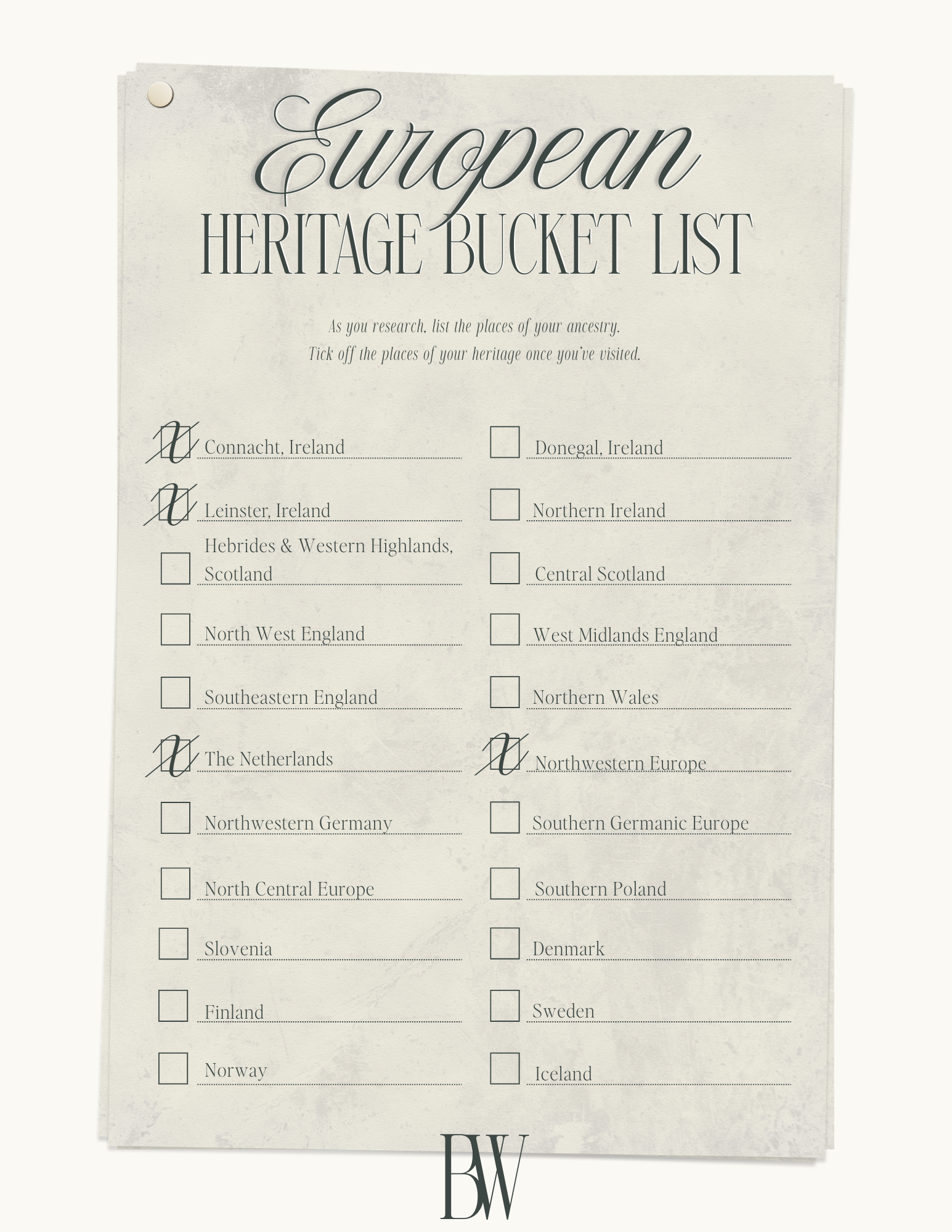
While I have specific cities and countries that I wish to travel to, I leaned heavily on both my parents’ AncestryDNA results to create a broad “European Heritage Travel Bucket List”. Below is the updated list, with all the places we’ve visited and will be visiting later this year.
I’ve also created a template copy that can be used to create your own travel list. Simply log into your Canva account and select “Make a Copy” to begin creating your own.