How To Conduct A Life Audit

2026 has come with its fair share of highs and lows, challenges and wins, and as I enter the last year of my 30s, I’ve been feeling more than ever before the desire to really hone in on my dreams and goals as I look toward the next decade of my life.
At least once a year—usually around my birthday—I like to sit down and conduct a life audit. I find these are most useful whenever I’m feeling overwhelmed with no idea where to focus my energy or turn to next.
What is a Life Audit?
I’m a big believer in using lists and plans and journals as tools to better know myself. A life audit is simply another tool I use whenever I feel I’ve strayed too far from my path, or, the path has disappeared completely in the tangle of life’s many responsibilities. An audit allows me to comb through every corner, check in with what’s working well, and what needs a little more of my time and attention. In its simplest form, it’s a no-judgement evaluation; a time to pause and really reflect. The goal isn’t to beat yourself up over the habits that have formed along the way. Rather, it’s an opportunity to reverse-engineer your goals so that your daily habits are better reflection of where you want to
How to Conduct a Life Audit
Before beginning, it’s important that you get into the right mindset. The audit is in no means a one-stop shop and once complete, the work is done. Think of the audit as the building block toward the life you most imagine living. You need to clear through all the weeds in order to reach the foundation of which to grow. It’s important that you give yourself enough time so you don’t feel rushed into decision-making. I love journaling, and so I like to set aside several hours to complete my audits, which I highly recommend as you’ll see why in the steps below.
STEP ONE: REFLECTWhen I conduct audits, I like to break each section of my life into 5 or 6 different areas, depending on what I feel needs the most attention. These will vary year to year as my focus and growth happens in different areas. Below are some ideas to get you started:
Spiritual
Social/Relationships
Travel
Self Care
Beauty
Nutrition
Business/Career
Wealth & Finances
Health
Home
Hobbies
Personal Growth
STEP TWO: BE HONESTTake a magnifying glass to the areas you’ve selected and be brutally honest with yourself. Ask questions like:
What’s working well? What isn’t?
How can I better support this area of my life?
What do I need to release?
This part will take the longest and be the most difficult. It can be hard to face habits that have become uncomfortable or even counter-intuitive to your long-term goals. Maybe you’ve selected “Wardrobe” as an area you’d like to highlight because your closet has become so full you dread getting dressed in the morning. Letting go of items that have sentimental attachments or coming face-to-face with the idea you need to keep every piece because that was money hard earned and ill spent, can be harsh realities and avoidance is a normal response. But the best course forward will be to take one small step toward your goals, even if it’s as simple as recycling or tossing that collection of socks that are missing their partners.
STEP THREE: TAKE ACTIONYou’ve highlighted the areas of your life you’d like to improve. You’ve shone a spotlight on each to uncover the hard truths. Now, you can begin to build a plan for change. For each area I select, I like to create actionable goals, the more specific the better. For example, if I’ve selected “Finance” as an area I’d like to focus on, a goal I might set would be: “Create an automatic savings rule to pay myself first.”
There’s two useful ways I’ve found when taking these action steps. One, is to habit-stack. For example, if I wanted to add a skincare regime to my evening ritual, I’d store the bottle of cream next to my toothpaste. When I’m reaching for one, the other is right there waiting.
The other option is to evaluate my daily rituals and make adjustments to better accomplish my goals.
Daily Rituals = Consistent Growth
Once you’ve audited the areas you’d like to bring change to, I find it’s also helpful to revisit those daily rituals and make small shifts to better support your new goals. Sometimes, what helps most is a screeching halt and pivot in a new direction. Daily rituals can help support and sustain those longer term goals.
MORNING RITUALWhenever I revisit my daily habits, I like to imagine the start of my “ideal” morning. One where I wake up without an alarm, I have time to enjoy my coffee and a simple breakfast before I get ready for the day. This looks different for everyone, but I find that visualization is key to better understanding what I’m hoping to accomplish.
AFTER WORK RITUALWhen you’ve completed your work day, how are you spending your time? Connecting with a partner or pets? Working out? Preparing an exquisite meal for yourself? Spending time on your hobbies?
EVENING RITUALAnd lastly, how are you ending your day? Do you prefer a bath or a shower? Reading? Do you enjoy a cup of tea or maybe a mocktail? What time is your bedtime?
While you can (and should!) make adjustments as needed, recommend giving both habit-stacking and daily rituals 30-days before making drastic shifts. Keep checking in with your journal, those areas you highlighted, and the action steps you created.
I completed my Life Audit! What’s Next?
The work of a life audit is never truly done. You may find after 30-days that an area you thought would require more effort, time and attention, really only needed a couple of weekends worth of focus. Maybe another area has popped up unexpectedly. I find anytime I’m experiencing overwhelmed or frustrated is about the time I need to sit with myself and reevaluate. These are the steps I return to again and again to help me focus on what’s most important at any given cycle of my life.
Vision Planning
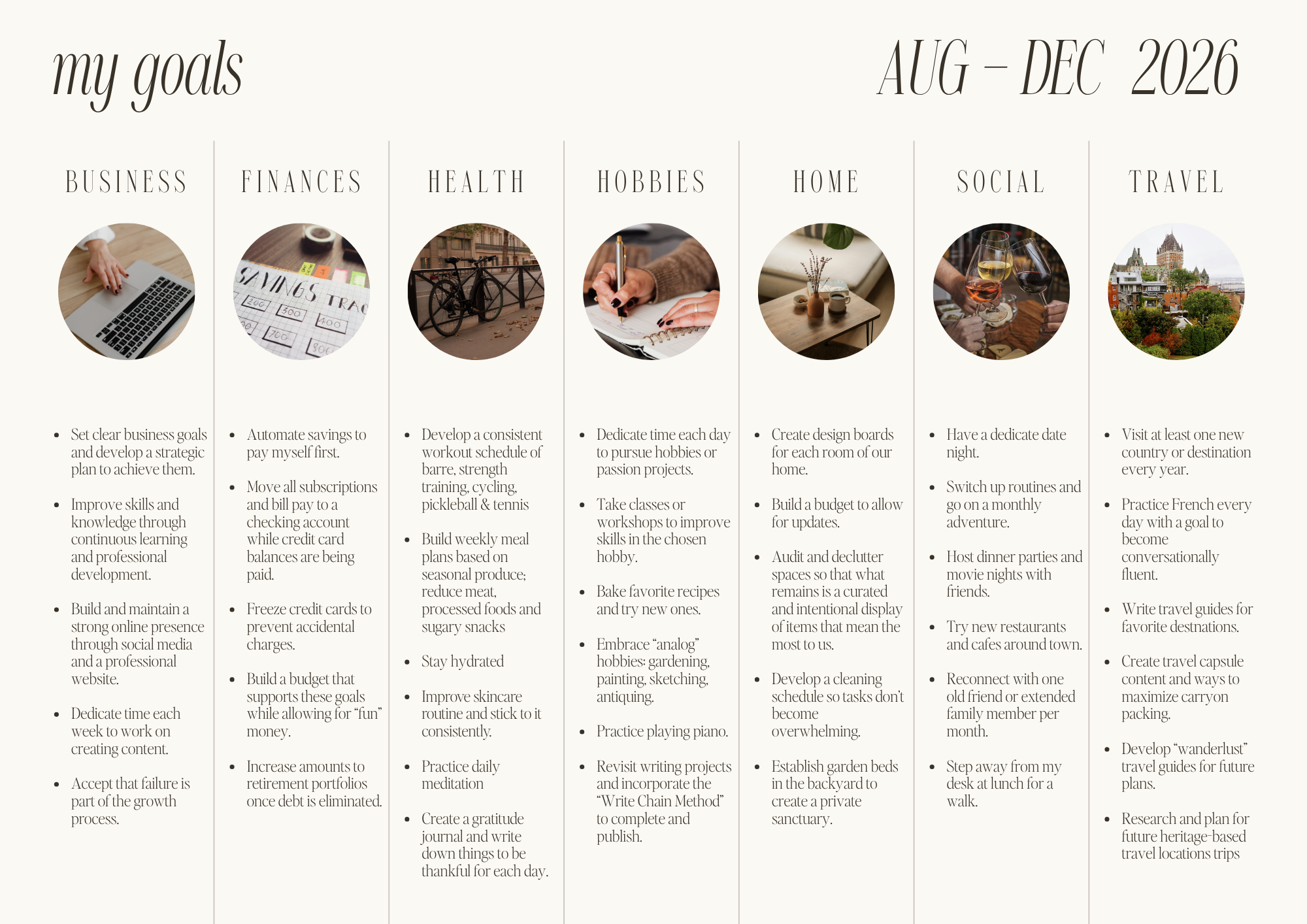
Additionally, I like to take the areas I highlight during an audit to create my vision planning goals for the next chapter of my life. Below is an example of my vision plan for the remainder of 2026 beyond. Vision planning is a great way to take all the thoughts from the life audit and organize those into a tangible table to execute. While I find vision boards obviously, visually appealing, personally, I prefer vision planning to a vision board because I like seeing the actionable things I’m working to accomplish rather than simply an image of a thing. I find it’s a great way to put all that time you spent auditing your life into easily reviewable goals for checkins.