Ethical Considerations in Family History Research
As it so often does, pulling on one thread of the family tapestry, often unravels a completely unrelated section. While researching a photograph from my archive, I turned to FamilySearch to verify census data addresses in an attempt to hone in on a location for the photo. Imagine my surprise when, clicking up the branches of the family tree, I encountered an alternate profile of my mother, displaying an intimate profile photo of her on her wedding day, that I did not create nor upload.
Immediately, I jumped into my eldest daughter role, demanding to know who would’ve created this profile and added these photos. As I clicked through image after image of my mother, I was filled with a rage I didn’t know existed at the absolute disrespect to my mother’s memory. Knowing my mother as I did, a woman who abhorred having her photo taken and was averse to any and all forms of “social networking” sites, the very idea that images would survive her online would've had her seeking legal action. And anyone who knew her, would know this.
Imagine my frustration at the lackadaisical response given by FamilySearch, shared below, at my request they remove the photos as they all contained images of living relatives. Most shocking of all, some of these photos were of my mother with her grandchildren, that had been shared privately to family members alone.
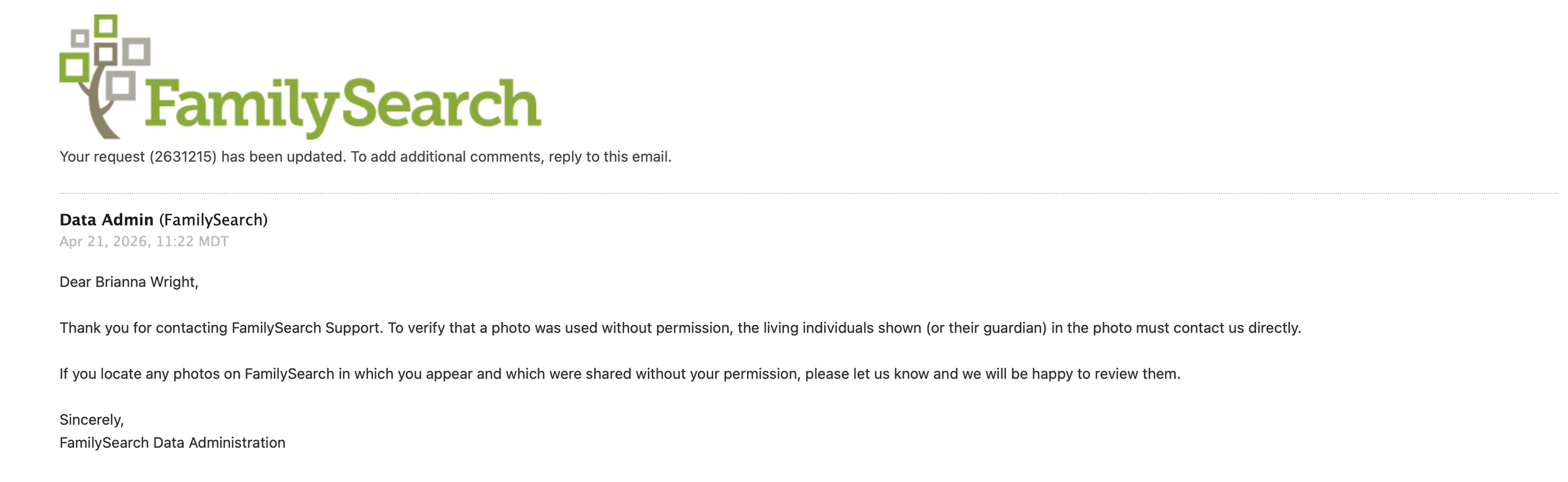
BRB, FamilySearch, let me get the guardians of children on the phone . . .
Truthfully, I’m not surprised at their response, given that LDS “baptizes” everyone into their church through family history. I am, however, shocked by the betrayal of my mother and disregard to the living by someone so close to her who should honestly know better. But therein lies the issue:
“Hobbyist family historians are not bound by a formal code of ethics in the same way as those who gain professional accreditation and offer their services for payment. They will of course have personal ethical principles but might be challenged as to the best course of action over issues arising from their research, for example, whether to present evidence to family members that a long-held family story is a myth. Some who may not have considered the ethical implications of their research strategies or follow-up behaviours can find themselves in uncomfortable and stressful situations. For example, the excitement and subsequent sharing of a ‘new discovery’ could cause consternation among family members and lead to relationship tensions and even break-downs. Not all family members will be happy to have family secrets exposed.” — Susan M. Moore
“Ethical Dilemmas and Family History: A Psychological Approach”
This experience did give me pause in my own sharing of family history, of which I have shared many, many histories. However, I’ve always done my best to cite my sources, rely heavily on first-person accounts and records, maintain an air of neutrality, and never share anything about living people, always keeping three generations in separation in regards to the information I share. By this I mean, never sharing anything regarding the following generations without their consent:
Gen 1 = Myself, siblings, partners, first-cousins/removed and any descendants of this generation
Gen 2 = Parents, aunts, uncles, second-cousins/removed and any descendants of this generation
Gen 3 = Grandparents*, great-aunts, great-uncles, third-cousins/removed
*The one exception to this rule is that I have shared newspaper clippings of my grandparents, all of which is publicly accessible, and as they have passed, I was unable to gain their consent.
I am deeply aware that simply because someone is not closely related to me, does not mean they do not still have living descendants. So when it comes to my own research and sharing, though I am not (yet) board certified, I do, and believe all family history hobbyists should, adhere to the Board for Certification of Genealogists code of Ethics and Standards:
To protect the public
I will not publish or publicize as a fact anything I know to be false, doubtful or unproved; nor will I be a party, directly or indirectly, to such action by others.
I will identify my sources for all information and cite only those I have personally used.
I will quote sources precisely, avoiding any alterations that I do not clearly identify as editorial interpretations.
I will present the purpose, practice, scope, and possibilities of genealogical research within a realistic framework.
I will delineate my abilities, publications, and/or fees in a true and realistic fashion.
I will not publish any personal, genealogical, or genetic information disclosed to me unless I have informed consent or omit personally identifying detail. I will also treat publicly available information about living people with sensitivity and will not publish any information with foreseeable potential for harm.
While I love researching those who came before me, in attempts to keep their memories and traditions alive, heal the generational traumas that we carry, and to humanize names and dates carved into stone, we also have to remember that not everything needs to be shared, and certainly not publicly. The history of genealogy as a whole is pretty gross when you zoom out, considering, not all that long ago, people once paid to have their pedigree compiled (and often falsified) in order to “prove” entitlements over land, power and titles. Our desire for answers and to share "breakthroughs and new discoveries, does not outweigh the harm done to others. And while you may not think anything of sharing photos or information about yourself online, the dead cannot speak for themselves and they still deserve privacy. How would you feel if this was your story being shared without your consent? What is a “historical fact” to you, may be a personal tragedy to someone else and that demands sensitivity and empathy.
The internet will outlive us all; think twice before you click post.